

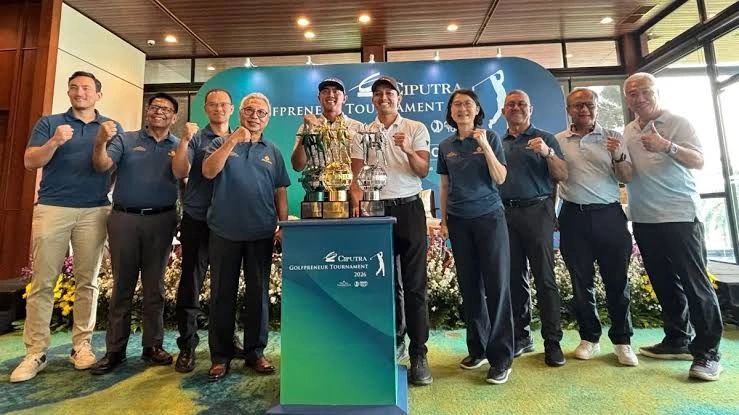
MCGJWC 2026 has received strong appreciation from Indonesia’s Ministry of Youth and Sports, or Kemenpora, as the international junior golf championship continues to play an important role in developing young athletes and giving Indonesian golfers valuable competitive experience.
The Mandiri Ciputra Golfpreneur Junior World Championship 2026 was held from June 10 to 12 at Damai Indah Golf’s PIK Course in Pantai Indah Kapuk, Jakarta. The tournament brought together 140 young golfers from 29 countries, turning Indonesia into an international stage for some of the most promising junior players in the sport.
At the closing ceremony, Secretary of the Ministry of Youth and Sports Gunawan Suswantoro praised the successful organization of the championship and expressed hope that tournaments such as MCGJWC could help produce Indonesian golfers capable of competing and achieving success at the world level.
For Indonesia, the importance of the tournament goes beyond determining who wins a trophy. It provides young players with international competition, opportunities to strengthen their mentality, improve their technique and understand the standards required to eventually compete as senior athletes.
What Is MCGJWC 2026?
MCGJWC stands for the Mandiri Ciputra Golfpreneur Junior World Championship, an international junior golf competition that brings together promising young golfers from Indonesia and many other countries.
The 2026 edition took place at Damai Indah Golf’s PIK Course in Jakarta and attracted 140 golfers representing 29 countries, including Indonesia, Australia, Bangladesh, Botswana, Cambodia, China, Japan, South Korea, Malaysia, New Zealand, the Philippines, Singapore, South Africa, Thailand, the United Arab Emirates, the United Kingdom and Vietnam.
The large international field gave Indonesian junior golfers the opportunity to compete directly against players with different competitive backgrounds and styles.
That experience is particularly valuable at junior level.
Training can improve technique, but tournament pressure introduces a completely different challenge. Players must manage concentration, emotions, strategy and decision-making while competing for a result.
MCGJWC provides exactly that type of environment.
Kemenpora Praises the Success of MCGJWC 2026
Kemenpora’s appreciation was delivered by Gunawan Suswantoro at the tournament’s closing ceremony on June 12.
Representing the Minister of Youth and Sports, Gunawan congratulated the organizers on successfully staging the international junior championship. He emphasized that the tournament helps young athletes develop their competitive mentality while supporting the broader development of golf in Indonesia.
Kemenpora also views junior competition as an important part of athlete regeneration.
Young golfers need opportunities to accumulate competitive experience before making the transition into senior and professional tournaments.
For that reason, an international event held at home can offer Indonesian players an important advantage.
They can experience a world-class competitive environment without always having to travel overseas.
MCGJWC 2026 Could Help Develop Indonesia’s Next Generation
One of the strongest messages from Kemenpora was the hope that MCGJWC 2026 could contribute to producing future Indonesian golfers with international achievements.
Gunawan said junior championships can prepare players to eventually take over from the current generation of senior athletes by increasing their competitive experience and improving their playing technique.
This process is important because successful athletes are rarely created through training alone.
Young players also need:
- Regular tournaments
- Strong competition
- International exposure
- Technical development
- Mental preparation
- Experienced coaches
- Long-term development programs
- Opportunities to progress into senior events
A tournament such as MCGJWC can become one piece of that development pathway.
It allows young players to understand where their performance stands compared with competitors from other countries.
140 Young Golfers From 29 Countries Compete in Jakarta
The international scale of the event was one of its biggest strengths.
A total of 140 junior golfers from 29 countries took part in the 2026 championship.
For Indonesian participants, competing against such a diverse field provides a different experience from playing only in domestic events.
International competition exposes junior golfers to players with different techniques, preparation methods and approaches to course management.
It can also create friendships and connections between young athletes from different countries.
Chairman of the Ciputra Golfpreneur Foundation Nararya Ciputra Sastrawinata highlighted this aspect of the event, describing the tournament as an opportunity to build togetherness and friendship among its international participants.
Thailand Takes the Major Individual Titles
The 2026 tournament ultimately produced an impressive performance from Thailand.
Parin Sarasmut won the Boys’ Division, while Kanyarak Pongpithanon claimed the Girls’ Division title. Thailand also won the team competition.
Parin finished the Boys’ competition at 12-under with a total score of 204, securing his second MCGJWC title after previously winning the tournament in 2023.
Kanyarak won the Girls’ Division at 8-under with a total score of 208. She finished ahead of a group of challengers that included New Zealand’s Sarah Simei Li, South Korea’s An Yun-ju and Indonesia’s Jennifer Quinn Effendi.
The results demonstrated the high level of competition Indonesian juniors faced during the event.
Jennifer Quinn Effendi Delivers an Impressive Result for Indonesia
Although Thailand claimed the main individual titles, Indonesia still produced encouraging performances.
One of the standout local players was Jennifer Quinn Effendi.
The 13-year-old Indonesian golfer finished tied for second in the Girls’ Division at 5-under with a total score of 211, alongside Sarah Simei Li of New Zealand and Yunju An of South Korea.
Jennifer’s performance was significant because she managed to remain competitive against some of the strongest international junior golfers in the field.
She was also recognized as the Girls Best Promising Indonesian Player, highlighting her potential as one of Indonesia’s young golfers to watch.
Results like this also support Kemenpora’s argument about the importance of high-level junior competition.
Young Indonesian athletes need the opportunity to test themselves directly against strong international opponents.
Indonesian Golfers Show Promising Potential
Jennifer was not the only Indonesian golfer to leave a positive impression.
In the Boys’ Division, Eugene Tanyongjaya finished 10th with rounds of 71, 71 and 73 for a total of 215, making him one of the leading Indonesian performers in a strong international field.
Indonesia also recorded a memorable moment in the Development Division when Amara Putri Alvanina made a hole-in-one on the third hole.
These achievements may not have produced the overall championship titles, but they illustrate the presence of promising local talent.
The challenge now is ensuring those young golfers continue receiving quality competition, coaching and development opportunities as they move toward higher levels.
Winners Receive Opportunities to Enter Professional Events
One of the most valuable features of MCGJWC 2026 is that success can lead to opportunities beyond the junior championship itself.
The Boys’ individual champion from Thailand earned an invitation to compete in the Ciputra Golfpreneur Tournament on the Asian Development Tour in 2026.
Meanwhile, the Girls’ champion earned an opportunity to compete in the Indonesia Women’s Open 2027.
This creates an important bridge between junior and higher-level competition.
A young golfer can participate in MCGJWC, perform well and then receive an opportunity to experience professional tournament conditions.
That type of pathway can be extremely valuable for players preparing for a future professional career.
International Competition Builds Mental Strength
Golf is a sport that requires more than technical skill.
Players need concentration, patience, emotional control and the ability to recover after mistakes.
A poor hole cannot be allowed to destroy the rest of the round.
Young athletes therefore need competition to learn how to handle pressure.
Kemenpora specifically highlighted the role of MCGJWC 2026 in developing the competitive mentality of junior golfers.
This may ultimately be one of the tournament’s greatest contributions.
A junior player who regularly competes against international opponents can become more comfortable with pressure and better prepared for major events later in their career.
Technical Development Also Matters
Mental development is only one part of the process.
International tournaments also challenge players technically.
Golfers must manage different situations throughout a round, including changes in wind, course conditions, difficult lies, putting pressure and strategic decisions.
Playing against strong opponents can reveal weaknesses that may not be obvious during training.
A player may discover that driving accuracy needs improvement.
Another may realize that putting becomes inconsistent under pressure.
Others may need better course management.
These lessons can then be taken back into training.
This is why tournaments should not be judged only by the final leaderboard.
For developing athletes, every competitive round can provide information that helps guide the next stage of improvement.
Indonesia Benefits From Hosting International Junior Golf
Hosting an international junior championship can also strengthen Indonesia’s position within the regional and global golf community.
The 2026 edition was notable because it received official sanction from the Asia-Pacific Golf Confederation (APGC) for the first time, according to the Asian Golf Industry Federation. The collaboration was intended to help broaden participation and improve the quality of the field.
That recognition adds value to the tournament.
It can make the championship more attractive to strong junior players and national golf programs looking for meaningful international competition.
For Indonesia, maintaining tournaments with a respected international field can also create more opportunities for local athletes to gain high-level experience at home.
MCGJWC Has a Long History of Junior Development
The championship itself has developed significantly over time.
According to the Asian Golf Industry Federation, the event was initiated 33 years ago by the late Dr. (HC) Ir. Ciputra. It began as a national championship before expanding to Southeast Asian level in 2004, Asian level in 2006 and world level in 2007.
That progression shows how a domestic junior competition can gradually develop into an international sporting event.
For Indonesian golf, continuity is important.
One successful tournament can provide experience.
A competition held consistently over many years can become part of an athlete-development system.
That is why Kemenpora expressed hope that the championship will continue in the future with an even broader reach and higher quality.
The Importance of Private-Sector Support in Indonesian Golf
The Ciputra Golfpreneur Foundation has played an important role in organizing junior development programs and competitions.
Earlier in 2026, Sports Minister Erick Thohir also praised the foundation for its commitment to supporting young golfers, including athlete development and educational opportunities.
The broader message is that athlete development cannot depend on government programs alone.
Successful sporting ecosystems usually involve cooperation among governing bodies, private organizations, coaches, clubs, sponsors, educational institutions and families.
For golf, where training, equipment and international competition can require significant resources, collaboration becomes particularly important.
Competitions such as MCGJWC demonstrate one way in which private-sector initiatives can complement national sports development.
Can MCGJWC Produce a World-Class Indonesian Golfer?
No tournament alone can guarantee the emergence of a world-class athlete.
However, MCGJWC 2026 provides several ingredients young players need: strong competition, international exposure, pressure, experience and a potential pathway toward higher-level tournaments.
The performance of players such as Jennifer Quinn Effendi shows that Indonesian juniors are already capable of competing near the top of an international field. Her tied-second finish in the Girls’ Division came against players representing several established golf nations.
The next challenge is continuity.
Young players need to continue competing after one strong result.
They need coaching, physical preparation, education, tournament opportunities and clear pathways into amateur and professional golf.
When those pieces work together, tournaments such as MCGJWC can become much more than annual sporting events.
They can become part of the foundation for long-term achievement.
A Positive Signal for Indonesia’s Golf Future
The success of MCGJWC 2026 gives Indonesian junior golf several reasons for optimism.
First, Indonesia demonstrated that it can host an international junior championship involving 140 golfers from 29 countries.
Second, Indonesian players were able to compete strongly against the international field, with Jennifer Quinn Effendi finishing tied for second in the Girls’ Division and Eugene Tanyongjaya placing 10th in the Boys’ Division.
Third, Kemenpora has publicly recognized the importance of this type of competition for building experience, technique and competitive mentality among young athletes.
Those elements provide a strong foundation.
The real test will be whether Indonesia can maintain consistent development from junior competition all the way to senior and professional golf.
Conclusion
MCGJWC 2026 was more than an international junior golf tournament. It represented an opportunity for Indonesia to develop young athletes, expose them to world-class competition and create pathways toward higher levels of the sport.
Held from June 10 to 12 at Damai Indah Golf’s PIK Course in Jakarta, the championship attracted 140 junior golfers representing 29 countries. Kemenpora praised the event and expressed hope that it will help produce future Indonesian golfers capable of achieving success on the world stage.
Thailand claimed the major individual titles through Parin Sarasmut and Kanyarak Pongpithanon, while Indonesia had encouraging performances of its own, particularly through 13-year-old Jennifer Quinn Effendi, who finished tied for second in the Girls’ Division.
The tournament also offers more than medals. Its individual champions receive opportunities to move into higher-level professional events, creating a valuable bridge between junior golf and the next stage of competition.
For Indonesia, the objective should therefore be bigger than simply hosting another successful championship.
The long-term goal is to turn international junior competition into a development platform—one that strengthens technique, builds mental resilience, increases competitive experience and eventually helps produce Indonesian golfers capable of competing with the best players in the world.




More Stories